A Different Class of Murder by Laura Thompson
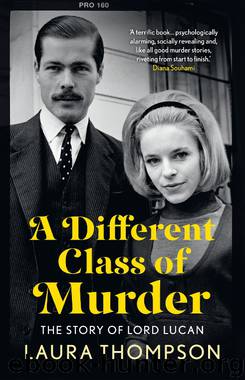
Author:Laura Thompson [Thompson, Laura]
Language: eng
Format: epub
ISBN: 9781781855355
Publisher: Head of Zeus
PART III
The Investigation
‘Was it possible, even remotely possible, that the man’s statement was true? Was this that thousandth case where circumstantial evidence, complete in every particular, was merely a series of accidents, completely unrelated and lying colossally in consequence? But then, the thinness of the man’s story – that fundamental improbability!’
JOSEPHINE TEY, The Man in the Queue, 1929
Murder
‘Blunt head injuries inflicted by a named person. Murder.’
FROM THE DEATH CERTIFICATE OF SANDRA ELEANOR RIVETT, REGISTERED IN JUNE 1975 BY THE CITY OF WESTMINSTER REGISTRAR
Possibly the greatest pleasure of reading detective fiction is the illusion it gives that there is such a thing as omniscience. Hercule Poirot, who applies order and method and finds that no problem can resist them; Lord Peter Wimsey, with his ‘now we know how, we know who’; Sherlock Holmes, who realizes that the absence of incident, the dog that does not bark, is as important a clue as its presence. Not for them the ambiguity, the obfuscation, the lies that cannot be penetrated. Nothing remains unknown. Truth has its own natural force, and must come to light if a brain is able to perceive it.
The surest means to find the truth is identified by Miss Marple. ‘So you see that if you disregard the smoke and come to the fire you know where you are. You just come down to the actual facts of what happened.’
Although in detective fiction this is always possible, Miss Marple’s creator, Agatha Christie, knew perfectly well that it was not so easy, in real life, to perceive what really happened. Smoke thickens around facts until it is impossible to see them glinting in the darkness. Christie was almost tormented by fascination with the cases of two unsolved domestic murders: the death of Charles Bravo in 1876 from antimony, and the Croydon poisonings of 1929–30, in which three members of the same family were killed with arsenic. Christie wrote of the Croydon case ‘that if I die and go to heaven, or the other place, and it so happens that the Public Prosecutor of that time is also there, I shall beg him to reveal the secret to me’.1 She herself tried very hard, but could not quite trace the thread of truth. How she must have longed to inhabit the idealized minds of her two detectives, and enable that cerebral deus ex machina!
Not long before her death she had made the sudden, questing remark: ‘I wonder what has happened to Lord Lucan?’ Had she lived longer, her interest would doubtless have deepened. Like the Bravo and Croydon cases, this was her sort of crime. It was about the mystery behind the façade. It was about motive, character, concealment: the human dynamic, writ large by murder.
It was also a case whose simplicity was deceptive. Classic domestic killing gone wrong? It certainly looked that way, but if Agatha Christie had written the story she would have argued that what seemed to have happened on 7–8 November could not have happened. Too many facts did not fit the official solution.
Download
This site does not store any files on its server. We only index and link to content provided by other sites. Please contact the content providers to delete copyright contents if any and email us, we'll remove relevant links or contents immediately.
Mindhunter: Inside the FBI's Elite Serial Crime Unit by John E. Douglas & Mark Olshaker(9343)
Wiseguy by Nicholas Pileggi(5787)
Room 212 by Kate Stewart(5123)
Hitman by Howie Carr(5096)
Secrecy World by Jake Bernstein(4753)
Killers of the Flower Moon: The Osage Murders and the Birth of the FBI by David Grann(4447)
Papillon (English) by Henri Charrière(4274)
Breaking Free by Rachel Jeffs(4218)
Killers of the Flower Moon by David Grann(4055)
Say Nothing by Patrick Radden Keefe(3987)
American Kingpin by Nick Bilton(3887)
The Secret Barrister by The Secret Barrister(3710)
Molly's Game: From Hollywood's Elite to Wall Street's Billionaire Boys Club, My High-Stakes Adventure in the World of Underground Poker by Molly Bloom(3536)
Mysteries by Colin Wilson(3456)
In Cold Blood by Truman Capote(3386)
Signature in the Cell: DNA and the Evidence for Intelligent Design by Stephen C. Meyer(3138)
I'll Be Gone in the Dark by Michelle McNamara(3082)
Rogue Trader by Leeson Nick(3045)
Bunk by Kevin Young(3001)
